

How to Store Diesel Fuel and Diesel-Powered Equipment
By on Aug 31 2026

Diesel-powered equipment is built to work, but extended periods of inactivity can create problems of their own.
Whether you’re storing a truck, generator, tractor, construction equipment, or a bulk supply of diesel fuel, proper preparation can help prevent fuel degradation, contamination, corrosion, and difficult startups when that equipment is needed again.
The challenge is not simply keeping diesel in a tank.
Today’s diesel fuels, including Ultra-Low Sulfur Diesel (ULSD) and biodiesel blends, can be affected by moisture, oxidation, temperature changes, and microbial contamination during storage.
The longer fuel and equipment sit unused, the more important proper storage becomes.
Fortunately, a few preventive steps can make a significant difference.
What Happens to Diesel Fuel During Storage?
Diesel fuel can deteriorate over time. It does not suddenly become unusable on a specific date, but storage conditions can gradually affect its quality.
Several conditions can affect stored diesel over time:
- Water contamination: Condensation, environmental moisture, and tank conditions can allow water to accumulate in a fuel system.
- Microbial growth: Bacteria and fungi can develop when water is present, particularly near the interface between fuel and accumulated water.
- Fuel oxidation and degradation: Extended storage can cause diesel to deteriorate, potentially contributing to sediment, deposits, and poor fuel quality.
- Tank contamination: Water, sludge, and other contaminants can eventually contribute to plugged fuel filters and fuel-system problems.
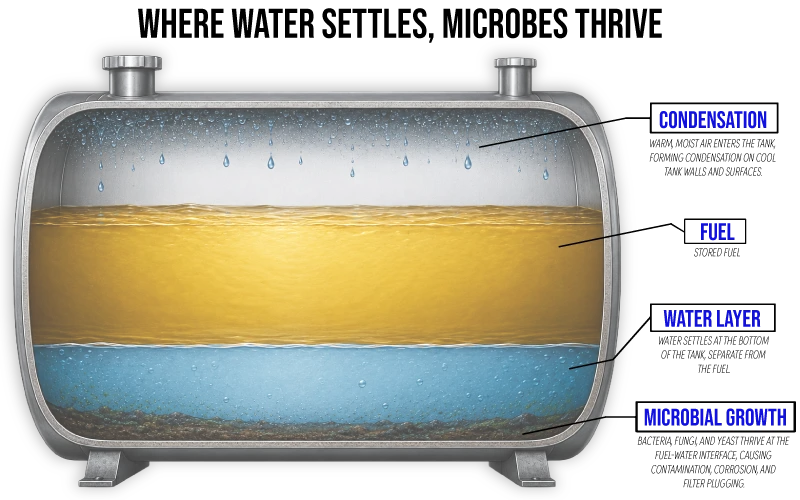
Biodiesel blends can present an additional storage consideration because biodiesel is more hygroscopic than conventional petroleum diesel, meaning it has a greater tendency to attract and retain moisture.
Outdoor and above-ground storage tanks can be particularly susceptible to moisture because repeated heating and cooling cycles can contribute to condensation inside the tank.
That makes water management and fuel stability two of the most important considerations when storing diesel.
How Long Can Diesel Fuel Be Stored?
There is no single storage life that applies to every tank of diesel.
Fuel quality, temperature, exposure to moisture and oxygen, tank cleanliness, biodiesel content, and overall storage conditions can all affect how quickly diesel deteriorates.
Rather than relying on a fixed expiration date, fuel expected to sit for an extended period should be periodically inspected and properly maintained.
The condition of the fuel matters more than simply how long it has been sitting.
Prepare Diesel Fuel Before Long-Term Storage
Preventive treatment is considerably easier than trying to recover a contaminated fuel system later.
Before placing diesel fuel or diesel-powered equipment into storage, inspect the fuel and tank for obvious signs of water, sludge, sediment, or contamination.
Whenever possible, begin with clean, good-quality fuel rather than attempting to preserve fuel that is already compromised.
For fuel that will remain unused for an extended period, consider using a diesel fuel treatment specifically designed for storage and tank maintenance.
Help Keep Stored Diesel Clean and Stable
Power Service Clear-Diesel Fuel & Tank Cleaner is one option available from PSC for maintaining stored diesel fuel.
Clear-Diesel is formulated to clean diesel fuel and fuel tanks, disperse contaminants, address water, help prevent premature fuel-filter plugging, and improve long-term storage stability.
That makes it particularly useful for applications such as:
- Bulk diesel storage tanks
- Farm and agricultural equipment
- Construction equipment
- Standby generators
- Seasonal equipment
- Diesel trucks or machinery that will remain idle
Always follow the manufacturer’s recommended treatment ratio for the amount of fuel being treated.
PSC’s Fuel Additive Calculator, available directly on the Power Service product pages, can also help determine the appropriate amount of select Power Service additives based on tank capacity.
Calculate Your Treatment Ratio
Use PSC’s built-in Fuel Additive Calculator to find the exact treatment amount for your tank.
Access Fuel Additive CalculatorWhich Diesel Treatment Do You Need?
Not every diesel fuel additive solves the same problem. Before choosing a treatment, identify what you are trying to prevent or correct.
| If Your Concern Is… | What You Need | Typical Solution |
|---|---|---|
| Fuel will sit unused for an extended period | Fuel stability and tank cleanliness | Power Service Clear-Diesel Fuel & Tank Cleaner |
| Bacteria or fungi are present | A diesel fuel biocide | Power Service Bio Kleen Diesel Fuel Biocide |
| Microbial contamination is present along with water, sludge, or other contaminants | Microbial control plus fuel and tank cleanup | Bio Kleen and Clear-Diesel, used according to manufacturer directions |
| Equipment or stored fuel will face freezing temperatures | Cold-flow and anti-gel protection | An appropriate diesel anti-gel from Power Service, Howes, K100, or another compatible product |
| Internal metal surfaces need protection during extended equipment storage | Corrosion protection appropriate for the equipment | Nox-Rust VCI 10, where applicable |
The important distinction is that a fuel storage treatment, biocide, anti-gel, and corrosion inhibitor perform different jobs.
Clear-Diesel is intended to help maintain fuel quality and tank cleanliness during storage.
Bio Kleen is specifically designed to control bacteria and fungi.
Anti-gel products address cold-weather fuel-flow problems, while corrosion-inhibiting products are intended to protect metal components during equipment storage.
In some situations, more than one treatment may be appropriate.
For example, a tank with confirmed microbial contamination may require a biocide to address the microorganisms along with a fuel and tank treatment to help manage remaining contaminants.
Always follow product label directions and the equipment or fuel-system manufacturer’s recommendations.
What If Microbial Growth Is Already Present?
A fuel stabilizer and a fuel biocide perform different jobs.
If bacteria or fungi are already growing in a diesel tank, a product specifically designed to control microbial contamination may be required.
Warning signs can include:
- Repeatedly plugged fuel filters
- Dark or slimy material in the tank
- Sludge or string-like material in fuel
- Contamination near the fuel-water interface
- Unusual odors
- Visible debris in water removed from the tank
For these situations, PSC offers Power Service Bio Kleen Diesel Fuel Biocide.
Bio Kleen is an EPA-registered diesel fuel biocide designed to kill bacteria and fungi associated with diesel fuel and water.
It can be used for both corrective treatment of contaminated tanks and preventive maintenance according to the manufacturer’s directions.
What Is “Diesel Algae”?
“Diesel algae” is a common term used to describe microbial contamination in diesel fuel systems, but the growth is generally associated with bacteria and fungi rather than true algae.
These microorganisms can develop when water is present in the fuel system, especially near the fuel-water interface.
This is why controlling water is an important part of preventing microbial contamination.
Be Prepared to Change Fuel Filters
Treating microbial contamination does not make the accumulated biomass simply disappear.
After treatment, dead microorganisms and loosened contamination can be picked up by the fuel system and trapped by the fuel filters.
If you’re treating a tank with known microbial contamination, keep replacement fuel filters available and monitor them closely until the system has been cleaned.
Depending on the severity of the problem, heavily contaminated tanks may also require professional tank cleaning or fuel polishing.
Don’t Forget About the Diesel Engine
Protecting the fuel is only part of long-term equipment storage.
When an engine remains idle, oil can gradually drain away from certain internal surfaces.
Moisture in the surrounding air can then contribute to corrosion on exposed metal components.
The appropriate storage procedure varies considerably by engine and equipment manufacturer, so the equipment owner’s manual should always be your primary reference.
Depending on the application and expected storage period, preparation may include:
- Changing the engine oil and filter
- Inspect and servicing coolant
- Treating or replacing stored fuel
- Checking belts, hoses, seals, and batteries
- Protecting exposed components from moisture
- Lubricating appropriate fittings and moving parts
- Protecting internal metal surfaces against corrosion
For equipment requiring additional internal corrosion protection, Nox-Rust VCI 10 is available from PSC.
Protecting Equipment with a Volatile Corrosion Inhibitor
Nox-Rust VCI 10 is a volatile corrosion-inhibitive lubricating oil designed for the preservation of ferrous metal parts inside enclosed systems.
Volatile corrosion inhibitors, commonly referred to as VCIs, create corrosion-inhibiting vapors within a sufficiently enclosed space.
These vapors help protect metal surfaces that may be above the normal oil level or otherwise difficult for a conventional lubricant film to reach.
Nox-Rust VCI 10 can be used for preservation applications involving equipment such as:
- Diesel engines
- Fuel tanks
- Transmissions
- Hydraulic systems
- Enclosed gear systems
- Other stored machinery
Application methods and concentrations vary depending on the equipment being protected.
Always follow the manufacturer’s instructions and the equipment manufacturer’s storage recommendations before adding a preservative oil to an engine, fuel system, transmission, or hydraulic system.
Consider Temperature When Storing Diesel
Long-term storage isn’t the only time diesel fuel requires attention.
If equipment or bulk fuel will remain outside during cold weather, diesel gelling and fuel-filter icing can become additional concerns.
Paraffin wax naturally present in diesel can begin forming crystals as temperatures fall.
Eventually, those crystals can restrict fuel flow and plug filters.
PSC carries a range of diesel fuel additives from brands including Power Service, Howes, and K100 for applications involving cold-weather protection, fuel-system maintenance, storage, and other diesel-fuel concerns.
The important distinction is that a diesel storage treatment and a diesel anti-gel aren’t necessarily interchangeable.
Storage treatments are intended to address concerns associated with fuel quality and storage.
Biocides are specifically intended to control bacteria and fungi.
Anti-gel additives are designed primarily to improve cold-weather fuel operability.
Select an additive based on the actual problem you’re trying to prevent, and confirm that it is compatible with your fuel and application.
Returning Diesel Equipment to Service
Proper storage should make recommissioning easier, but equipment that has been sitting for an extended period should still be inspected before returning to normal operation.
Before startup, consider checking:
- Fuel condition and the bottom of the tank for water or contamination
- Fuel filters and water separators
- Engine oil level and condition
- Coolant level and condition
- Battery condition
- Belts, hoses, seals, and fittings
- Hydraulic and transmission fluid levels, where applicable
- The surrounding area for signs of leaks
Follow the equipment manufacturer’s recommissioning procedure, particularly when fogging oils, preservatives, or other long-term storage products have been used.
A Little Preparation Can Prevent a Much Bigger Problem
Diesel equipment is often stored because it isn’t needed right now, but when it is needed again, it usually needs to work.
Managing moisture, maintaining fuel quality, controlling microbial contamination, and protecting internal metal surfaces can help reduce the problems associated with extended downtime.
PSC carries a wide range of fuel additives and diesel maintenance products, including Power Service Clear-Diesel, Power Service Bio Kleen, Nox-Rust VCI 10, cold-weather fuel treatments, lubricants, coolants, greases, and other maintenance supplies for everything from individual trucks and generators to fleets, farms, and industrial operations.
Choosing the right treatment depends on the condition of the fuel, how long the equipment will be stored, the environment it will be stored in, and the requirements of the equipment manufacturer.
Shop Diesel Fuel Additives & Storage Maintenance Products
Explore PSC's line of treatments from Power Service, Howes, K100, Nox-Rust, and more.
Browse All Diesel ProductsFrequently Asked Questions About Diesel Fuel Storage
Does diesel fuel go bad?
Yes. Diesel fuel can deteriorate during storage due to oxidation, moisture, contamination, and microbial activity. How quickly that happens depends heavily on storage conditions and the condition of the fuel and tank.
How long can diesel fuel be stored?
There is no single storage life that applies to every tank of diesel. Fuel quality, temperature, exposure to moisture and oxygen, tank cleanliness, biodiesel content, and storage conditions can all affect how quickly diesel deteriorates. Fuel expected to sit for an extended period should be periodically inspected and properly maintained rather than relying on a fixed expiration date.
Should I treat diesel fuel before storing it?
For extended storage, a fuel treatment designed to improve storage stability and maintain tank cleanliness can be beneficial. Power Service Clear-Diesel, available from PSC, is formulated for diesel fuel and tank cleaning and long-term storage stability. Always follow the product’s recommended treatment ratio.
Should a diesel tank be full or empty during storage?
The correct approach depends on the equipment and tank design. Reducing empty headspace can sometimes help limit condensation, but fuel quality, expansion space, tank venting, storage duration, and manufacturer recommendations also need to be considered. Follow the equipment or tank manufacturer’s storage instructions rather than automatically filling every tank completely.
Can bacteria or fungus grow in diesel fuel?
Yes. Microorganisms can develop in diesel storage systems when water is present. Growth commonly occurs near the interface between the diesel fuel and accumulated water and can create sludge, corrosion-related issues, and plugged fuel filters.
Is diesel algae actually algae?
Usually not. “Diesel algae” is a common informal term for microbial contamination in fuel systems. The contamination is generally associated with bacteria and fungi that can develop where diesel fuel and water are present.
How do I know if my diesel fuel has microbial contamination?
Common signs include frequently plugged filters, dark or slimy material, sludge, string-like growth, debris in tank bottoms or removed water, and unusual odors. Power Service Bio Kleen Diesel Fuel Biocide is designed to control bacteria and fungi in diesel fuel systems when used according to its directions.
What’s the difference between Clear-Diesel and Bio Kleen?
They address different conditions. Power Service Clear-Diesel is primarily a fuel and tank cleaner designed to disperse contaminants, address water, prevent premature filter plugging, and improve diesel fuel’s long-term storage stability. Power Service Bio Kleen is a registered biocide specifically designed to kill bacteria and fungi associated with diesel fuel and water. If microbial contamination is suspected, use a product specifically approved for that purpose and follow all label directions.
Do I need to change my fuel filter after treating contaminated diesel?
If a tank has substantial microbial growth or accumulated contamination, filter changes may be necessary after treatment. Dead microorganisms and loosened debris can travel through the fuel system and become trapped in the filters. Keeping replacement filters available is a good precaution when treating known contamination.
Does diesel fuel need anti-gel during storage?
Only when temperatures make fuel gelling a concern. Anti-gel additives are designed primarily to improve cold-weather operability and reduce wax-related fuel-flow problems. They should not automatically be considered substitutes for products intended for long-term fuel stability or microbial control. PSC carries diesel fuel additives from Power Service, Howes, K100, and other brands for different fuel-treatment needs.
How should I protect a diesel engine during long-term storage?
Follow the engine manufacturer’s storage procedure first. Depending on the equipment and length of storage, preparation may include servicing the oil and coolant, treating the fuel, protecting batteries, lubricating appropriate components, and using a corrosion-preventive product for internal metal surfaces. For appropriate applications, PSC offers Nox-Rust VCI 10, a volatile corrosion-inhibitive lubricating oil designed to protect ferrous metal components within enclosed systems.
Where can I find the right diesel fuel treatment?
PSC carries a broad selection of diesel fuel additives and treatments from manufacturers including Power Service, Howes, and K100, with options for fuel storage, tank hygiene, microbial contamination, cold-weather protection, injector performance, and general diesel maintenance. For Power Service products, PSC’s Fuel Additive Calculator is also built directly into applicable product pages to help determine the appropriate treatment amount for your tank.